What Is the Difference Between a Speech Delay and Autism?
As a speech-language pathologist, one of the questions I hear most often from parents is:
"My child isn't talking yet. Could it be autism?"
It's completely natural to wonder. While delayed speech can be one characteristic of autism, a speech delay alone does not mean a child has autism. Many children with speech or language delays are not autistic, and many autistic children have unique communication strengths.
Understanding the difference can help parents know what to watch for and when to seek professional guidance.
What Is the Difference Between a Speech Delay and Autism?
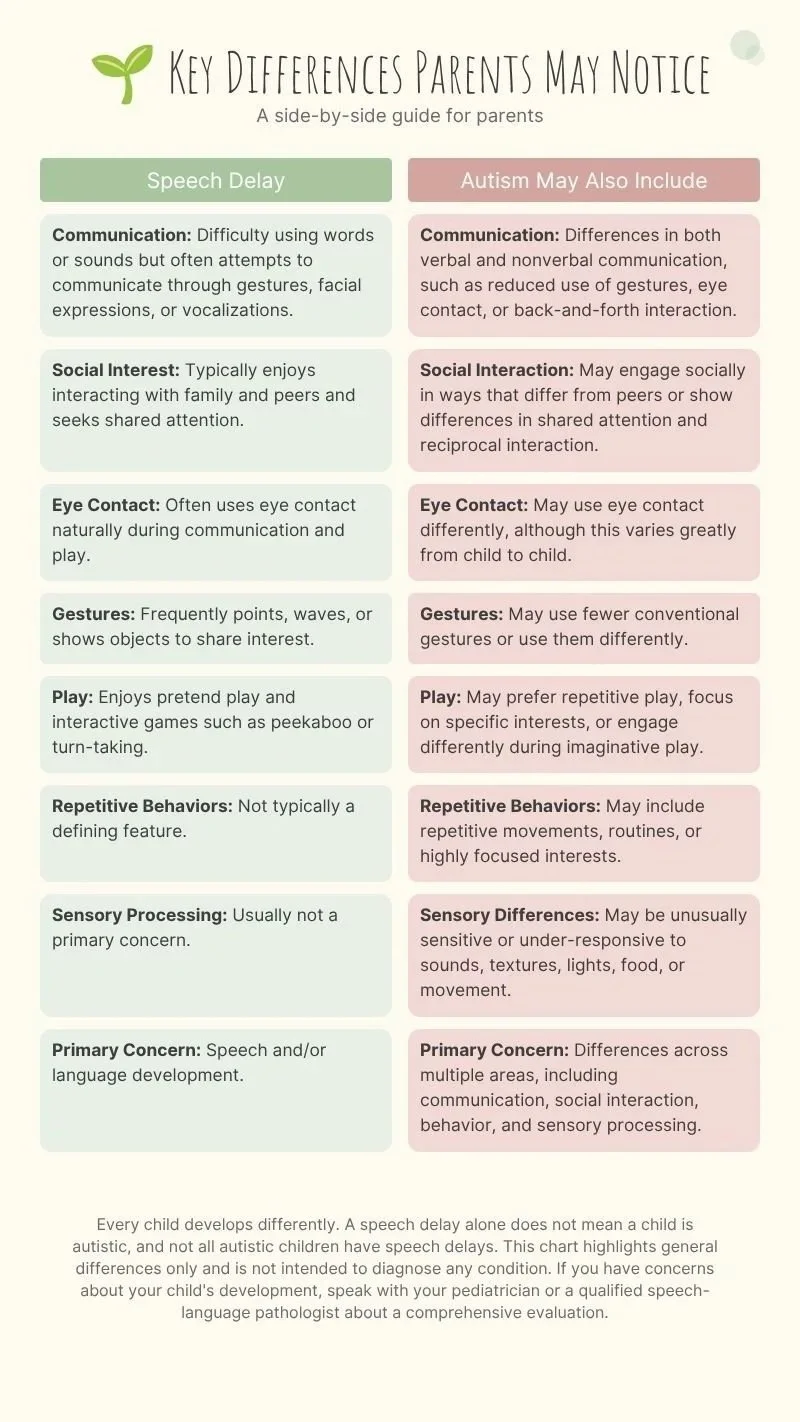
A speech or language delay primarily affects a child's communication development, while autism is a neurodevelopmental difference that involves patterns of social communication and interaction as well as restricted or repetitive behaviors, interests, or sensory differences. A speech delay by itself does not mean that a child is autistic, and autistic children can have a wide range of speech and language abilities. A comprehensive evaluation can help families better understand a child's individual communication and developmental profile.
What Is a Speech Delay?
A speech delay means a child is developing speech or language skills more slowly than expected for their age.
Children with speech or language delays may communicate in many different ways, including through gestures, facial expressions, sounds, words, or other forms of communication. Looking at a child's overall communication and developmental profile—not one individual behavior—is important when determining whether additional evaluation may be appropriate.
What Is Autism?
Autism Spectrum Disorder (ASD) is a neurodevelopmental difference that affects how a person communicates, interacts socially, and experiences the world. Autism presents differently in every individual, and no two autistic children are exactly alike.
Communication differences are only one part of autism. Children may also have differences in:
Social interaction
Play skills
Repetitive behaviors or movements
Sensory processing
Interests and routines
Some autistic children develop spoken language later, while others develop language on time or have advanced vocabularies.
Can a Child Have Both?
Yes.
Some autistic children also have speech or language delays, while others do not. Likewise, many children with speech delays are not autistic.
A comprehensive evaluation looks at your child's overall communication, social interaction, play, learning, and development to better understand their individual strengths and needs.
When Should Parents Seek an Evaluation?
If you notice concerns about your child's communication or overall development, it's a good idea to speak with your pediatrician or a speech-language pathologist.
Consider an evaluation if your child:
Is using very few words for their age.
Doesn't respond consistently to their name.
Has difficulty communicating wants and needs.
Doesn't point to share interest or show you things.
Has limited back-and-forth interactions.
Has lost words or skills they previously used.
You have concerns about their communication or development.
Early evaluation provides information and guidance—it does not automatically lead to a diagnosis.
How a Speech-Language Pathologist Can Help
Speech-language pathologists evaluate communication skills, including:
Understanding language
Expressing ideas
Speech sound development
Play skills
Social communication
Gestures and nonverbal communication
If additional concerns are identified, families may be referred to other professionals for a more comprehensive developmental evaluation.
Trust Your Instincts
Parents know their children better than anyone else.
If you have questions about your child's communication or development, talking with a qualified professional can help you better understand your child's strengths and determine whether additional evaluation or support may be helpful.
At Little Garden Speech & Language Therapy Services, we believe every child deserves individualized support that builds on their unique strengths. We're here to partner with families, answer questions, and help children grow their communication skills with confidence.